Missed Form 5472 for Past Years? Step-by-Step Catch-Up Guide
Missed Form 5472 filings? Discover how to catch up on late Form 5472 filing, prepare pro forma Form 1120, submit reasonable cause, and handle IRS penalties.
If you missed filing Form 5472 for past years, you can catch up by preparing a complete delinquent return packet for each missing calendar year and submitting it directly to the IRS. A late Form 5472 filing means sending, for each missing year, Form 5472 attached to a pro forma Form 1120. The IRS also lets you attach a reasonable cause statement explaining why the filing was late, and you should.
Taking action before the IRS contacts you is essential. The standard penalty under Internal Revenue Code Section 6038A is $25,000 per missing form, per year. By understanding the required forms, where to submit them, and how penalty relief works, you can bring your foreign-owned US entity back into good standing.
In short:
- Foreign-owned single-member LLCs (disregarded entities) must file Form 5472 attached to a pro forma Form 1120 for every missed year.
- The penalty for failure to file is $25,000 per Form 5472, per year. If the failure continues more than 90 days after the IRS notifies you, an additional $25,000 applies for each related party for every 30-day period (or part of one).
- Relief is not automatic, but it exists: reasonable cause (a written statement signed under penalties of perjury, applied "liberally" to small companies that did not know the rule) and, in some first-time cases, First-Time Abatement under the IRS manual.
- Foreign-owned US disregarded entities cannot e-file; each catch-up packet must be submitted by fax or mail to the IRS PIN Unit in Ogden, Utah.
- If a penalty notice arrives, answer it by its deadline and ask for abatement based on reasonable cause (Form 843 is the form for that request).
How much is at stake
The IRS manual (IRM 20.1.9.5.4) explains how the penalty is counted: an initial $25,000 "for each failure during a taxable year", asserted "once per related party per taxable year even if multiple infractions have occurred". A continuation penalty of $25,000 per 30-day period (or part of one) starts if the failure continues more than 90 days after the IRS mails its notice.
| Situation (one owner, no other related party) | Initial penalty exposure |
|---|---|
| 1 missing year | $25,000 |
| 2 missing years | $50,000 |
| 3 missing years | $75,000 |
| Each year still missing 90 days after an IRS notice | + $25,000 per 30-day period |
These are maximum exposures, not what you will necessarily pay: the relief options below exist precisely for founders who did not know the rule.
Who needs this
You need this catch-up procedure if your business meets all of the following criteria:
- You own a US Limited Liability Company (LLC) formed under state law.
- You are a non-US citizen and non-US resident who is the sole direct or indirect owner (making the LLC a foreign-owned US disregarded entity, or "DE").
- The LLC had reportable transactions with you during past tax years (capital you put in, money you took out, loans, LLC costs you paid personally, payments for services or goods between you and the LLC).
- You failed to file Form 5472 and the accompanying pro forma Form 1120 by the statutory due date for one or more past calendar years.
You do NOT need this procedure if:
- Your LLC has two or more owners and is treated as a partnership by default (it files Form 1065 instead).
- Your LLC elected to be taxed as a corporation on Form 8832. It then files a full Form 1120 each year, with Form 5472 attached, and the catch-up looks different. (An LLC owned by a non-resident cannot be an S corporation.)
- Your LLC had no reportable transactions of the types described in Parts IV, VI, or V of Form 5472 during the relevant tax year.
What you need before you start
Before drafting your late Form 5472 filing, assemble the following records:
- Company Formation Documents & EIN Confirmation Letter (CP 575 or 147C): Confirms the exact legal name, state of formation, date of incorporation/formation, and Employer Identification Number (EIN).
- Owner Identification Data: The foreign owner’s full legal name, permanent foreign residential address, country of citizenship, and Foreign Taxpayer Identification Number (FTIN) issued by their home country tax authority.
- Full Bank and Financial Statements for Each Missed Year: Needed to trace all monetary transactions between the LLC and you (or any related party), including owner investments, distributions, expense reimbursements, and service fees.
- Exchange Rate Records: the instructions ask for all amounts in US dollars and a schedule showing the exchange rates used, so keep the rates you applied to any foreign-currency transfer.
- Timeline and Written Proof of Delayed Filing: Written logs, medical notes, records of disruption, or communications explaining why the returns were not submitted on time.
Step-by-step catch-up process
Need to see each line filled in? Our Form 5472 line-by-line guide shows the official forms completed for a full example.
Step 1: Prepare the pro forma Form 1120 for each tax year
A foreign-owned US disregarded entity (DE) has no corporate income tax liability, but the IRS requires Form 5472 to be attached to a "pro forma" Form 1120 (U.S. Corporation Income Tax Return). Under the Instructions for Form 5472 (Rev. December 2024), a foreign-owned U.S. DE completes only limited lines on the first page of Form 1120:
Across the top of the Form 1120, write clearly: "Foreign-owned U.S. DE".
| Line on Form 1120 | What the form asks | What to enter | Example |
|---|---|---|---|
| Tax Year | For calendar year or tax year beginning/ending | Enter the calendar year dates for the missing tax year | Beginning: 01/01/2023, Ending: 12/31/2023 |
| Name | Name of corporation | Exact legal name of the LLC | Atlas Cloud Solutions LLC |
| Address | Street, suite, city, state, ZIP | Legal mailing address of the LLC | 123 Main St, Ste 100, Dover, DE 19901 |
| Item B | Employer identification number | The LLC's 9-digit federal tax number | 12-3456789 |
| Item E | Checkboxes for return status | Check box (1) if it is the initial return, otherwise leave blank unless applicable | Check box (1) Initial return (if Year 1) |
| Sign Here | Signature of officer, Date, Title | Signed by the foreign owner, dated, with their title | Signature of owner, 03/15/2025, Title: "Managing Member" |
Leave every numbered line on page 1 (income, deductions, tax and payments) and all the other pages and schedules blank: the instructions say the only information required is the name, address and items B and E.
Step 2: Complete Form 5472
Use the revision of the form that applies to each missing year (the current one is Rev. December 2023; earlier revisions are available on irs.gov). The walkthrough below follows Rev. December 2023.
You must prepare a separate Form 5472 for each foreign owner or related party with whom the LLC had reportable transactions. For a single-member LLC owned by a foreign founder, the foreign owner is both the direct 25% foreign shareholder and the related party.
Part I, Reporting Corporation
All reporting corporations must complete Part I.
| Line | What the form asks | What to enter | Example |
|---|---|---|---|
| 1a | Name and address of reporting corporation | Legal name and address of the LLC | Atlas Cloud Solutions LLC, 123 Main St, Ste 100, Dover, DE 19901 |
| 1b | Employer identification number | The 9-digit EIN of the LLC | 12-3456789 |
| 1c | Total assets | Total ending assets in US dollars per books | $15,200 |
| 1d | Principal business activity | Description of commercial activity | Computer Systems Design Services |
| 1e | Principal business activity code | 6-digit NAICS code | 541512 |
| 1f | Total value of gross payments made or received reported on this Form 5472 | Lines 22 and 36 of Part IV, plus the value of Part VI transactions and, for a foreign-owned U.S. DE, the Part V transactions | $14,000 |
| 1g | Total number of Forms 5472 filed for the tax year | Total forms filed for this tax year | 1 |
| 1h | Total value of gross payments reported on all Forms 5472 | Same as 1f if filing only one form | $14,000 |
| 1j | Initial year checkbox | Check it if this is the first Form 5472 the LLC files. In a catch-up, that is the return for the earliest year | Checked on the earliest year only |
| 1l | Country of incorporation | The country under whose laws the LLC was formed | United States |
| 1m | Date of incorporation | Date the LLC was legally formed | 02/10/2022 |
| 1n | Country(ies) under whose laws the reporting corporation files an income tax return as a resident | A disregarded LLC does not file an income tax return in its own name. Practice varies on what to enter; confirm with your preparer | Confirm with your preparer |
| 1o | Principal country(ies) where business is conducted | Country or countries where operations take place | France |
| Line 2 | 50% foreign ownership checkbox | Check if foreign person owns at least 50% | Checked |
| Line 3 | Foreign-owned domestic disregarded entity checkbox | Check this box if foreign-owned U.S. DE | Checked |
Lines 1i and 1k: Leave blank unless applicable.
Part II, 25% Foreign Shareholder
Complete lines 4a through 4e for the direct owner.
| Line | What the form asks | What to enter | Example |
|---|---|---|---|
| 4a | Name and address | Full legal name and foreign address of owner | Jean Dupont, 12 Rue de la Paix, 75002 Paris, France |
| 4b(1) | U.S. identifying number, if any | SSN or ITIN (if assigned) | Leave blank if none |
| 4b(2) | Reference ID number | Optional for a foreign-owned LLC (the instructions say you "can" enter one). If you create one: letters and digits, no spaces, max 50 characters, the same every year | JDUPONT01 (optional) |
| 4b(3) | FTIN, if any | A foreign-owned LLC must enter the owner's FTIN, or "None"/"N/A" if there is none | 0123456789012 |
| 4c | Principal country(ies) where business is conducted | Country where owner conducts business | France |
| 4d | Country of citizenship, organization, or incorporation | Country of citizenship | France |
| 4e | Country(ies) of tax residence | Country where owner files tax return as resident | France |
Lines 5a–7e: Leave blank if there are no other direct or indirect 25% owners.
Part III, Related Party
Complete Part III for the owner or entity that engaged in transactions with the LLC. Check the box indicating whether the related party is a foreign person or U.S. person.
| Line | What the form asks | What to enter | Example |
|---|---|---|---|
| Part III Header | Foreign person or U.S. person | Check applicable box | Checked: "foreign person" |
| 8a | Name and address of related party | Name and address of foreign owner | Jean Dupont, 12 Rue de la Paix, Paris, France |
| 8b(1) | U.S. identifying number, if any | ITIN or SSN if available | Leave blank if none |
| 8b(2) | Reference ID number | If you created one for Part II, repeat it here | JDUPONT01 (optional) |
| 8b(3) | FTIN, if any | Foreign Taxpayer Identification Number | 0123456789012 |
| 8c | Principal business activity | Activity of the related party | Software Consulting |
| 8d | Principal business activity code | 6-digit NAICS code | 541512 |
| 8e | Relationship | Check the boxes that apply. The owner is the 25% foreign shareholder; many preparers also check "Related to reporting corporation" | "25% foreign shareholder" (and often "Related to reporting corporation") |
| 8f | Principal country(ies) where business is conducted | Operating country | France |
| 8g | Country(ies) of tax residency | Country where related party pays taxes | France |
Part IV, Monetary Transactions Between Reporting Corporation and Foreign Related Party
Part IV is for business transactions between the LLC and you: fees the LLC paid you for services (line 29), goods it bought from your foreign company (line 23), loans in either direction (lines 17 and 31), and so on.
Do not put capital contributions or distributions on lines 21 and 35. The instructions limit those lines to amounts "taken into account in determining the taxable income of the reporting corporation." Contributions and distributions are reported in Part V instead.
Because you checked "foreign person" in Part III, Part IV must be completed: enter the lines that apply. If none apply, lines 22 and 36 total zero.
Part V, Reportable Transactions of a Foreign-Owned U.S. DE
Check the box in Part V if the LLC had any transaction described in Regulations section 1.482-1(i)(7) not already entered in Part IV. This includes amounts paid or received in connection with the formation, dissolution, acquisition, and disposition of the entity, including capital contributions and distributions. Attach a statement describing these transactions, specifying the date, nature, and amount in US dollars.
Part VI, Nonmonetary Transactions
Leave blank unless property or services were exchanged without monetary consideration. If applicable, check the box and attach an explanatory statement.
Part VII, Additional Information
All filers must answer the questions in Part VII:
- Line 37: Check "No" (unless importing goods from related party).
- Line 38a–38c: Leave blank if line 37 is "No".
- Line 39: Check "No" (unless in a Cost Sharing Arrangement).
- Line 40a: Check "No" (disallowed deductions under section 267A).
- Line 41a: Check "No" (foreign-derived intangible income deduction).
- Line 42a, 42b: these ask about loans between the LLC and a related party and the interest rate used. With no loan, check "No". If you lent money to the LLC or borrowed from it, even without interest, read the instructions for these lines with your preparer.
- Lines 43a, 43b(1), 43b(2): Do not complete if the reporting corporation is a foreign-owned U.S. DE (per the official instructions).
Parts VIII and IX: Do not apply to a standard foreign-owned single-member LLC. Leave blank.
Step 3: Write the Reasonable Cause Statement
Penalty relief requires showing that the failure to file was due to reasonable cause and not willful neglect. The IRS allows you to attach a reasonable cause statement to each late information return.
Write one statement per year, sign and date it, and place it behind the Form 5472. The IRS manual is explicit: to show reasonable cause for a Form 5472 penalty, the reporting corporation "must make an affirmative showing of all the facts alleged as reasonable cause for the failure in a written statement containing a declaration that it was made under the penalties of perjury" (IRM 20.1.9.5.5, citing Treas. Reg. 1.6038A-4(b)). So end the statement with a sentence such as: "Under penalties of perjury, I declare that I have examined the facts stated in this statement and, to the best of my knowledge and belief, they are true, correct, and complete."
Two more points from the same section of the manual are worth knowing:
- Reasonable cause "will be applied liberally" when a small corporation (gross receipts of $20,000,000 or less) had no knowledge of the Form 5472 requirement, has limited presence in and contact with the United States, and promptly and fully complies with IRS requests. That describes most founders abroad, so say so clearly in your statement.
- The manual recommends that reasonable cause "not be considered for any year until all delinquent returns have been filed". File every missing year, not just one.
Your statement should cover:
- Facts and Dates: Exactly when the business was established, when the obligation arose, and when you became aware of it.
- The Cause of the Delay: The specific circumstances that prevented timely filing (for example reliance on a formation service or adviser who told you nothing else was due, serious illness, or other events outside your control). Simply not knowing the rule is generally a weak argument on its own; show what you did to stay compliant and how fast you acted once you found out.
- Ordinary Business Care and Prudence: Evidence that you took steps to determine your tax obligations, maintained organized records, and rectified the situation immediately upon learning of the requirement.
- Absence of Tax Avoidance: A statement confirming that the LLC had no US corporate income tax due and that the failure did not result in underpayment of federal tax.
A statement built on Jean's example could look like this:
Template, adapt to your facts
Atlas Cloud Solutions LLC, EIN 12-3456789
Reasonable cause statement, Form 5472 and pro forma Form 1120, tax year 2023
1. Facts. The LLC was formed in Delaware on February 10, 2022. I, Jean Dupont, a French resident, am its sole owner. In 2023 I contributed $4,000 to the LLC and received $10,000 in distributions.
2. Why the return was late. [Explain the specific reason, with dates and documents: for example, the formation service I used told me in writing on [date] that no federal filing was due because the LLC had no US income.]
3. What I did once I learned of the requirement. On [date] a tax professional informed me of the Form 5472 requirement. I gathered the records and filed all missing years ([list]) on [date].
4. Ordinary business care. The LLC is small (gross receipts well under $20,000,000), has limited presence in the United States, had no US income tax due, and I have complied promptly with the requirement as soon as I knew of it.
Under penalties of perjury, I declare that I have examined the facts stated in this statement and, to the best of my knowledge and belief, they are true, correct, and complete.
Signature, name, title (sole member), date
Step 4: Know what the IRS delinquent-return page says
The IRS page on delinquent international information returns covers taxpayers who "are not under a civil examination or a criminal investigation by the IRS and have not already been contacted by the IRS about the delinquent information returns." Its guidance is short and worth reading as written:
- File the late returns "through normal filing procedures." For a foreign-owned LLC, that means the pro forma Form 1120 with Form 5472, sent by fax or mail as below.
- "Penalties may be assessed in accordance with existing procedures."
- You "may attach a reasonable cause statement to each delinquent information return," but "during the processing of the delinquent information return, penalties may be assessed without considering the attached reasonable cause statement. It may be necessary for taxpayers to respond to specific correspondence from the IRS and submit or resubmit reasonable cause information."
In other words, filing late does not come with an automatic waiver. Filing before the IRS contacts you, with a clear and documented statement, simply puts you in the best position to ask for relief.
Worked example
Jean is a French resident who formed Atlas Cloud Solutions LLC, a single-member Delaware LLC, on February 10, 2022. Jean is the 100% owner. He did not know that foreign-owned disregarded entities had to file Form 5472.
In early 2025, while reviewing his accounting with a tax professional, Jean learned he had missed filing for both the 2022 and 2023 tax years.
Here are Jean’s facts for the 2023 calendar year:
- Total company assets on December 31, 2023: $15,200 (Line 1c)
- Capital contributed by Jean to the LLC: $4,000 (Part V)
- Distributions paid by the LLC to Jean: $10,000 (Part V)
- Part IV: no business transactions with Jean, so lines 22 and 36 total zero
- Part I, Line 1f and Line 1h: $14,000 (the Part V transactions)
- Identifiers: Jean has no ITIN. He enters his French FTIN on 4b(3) and 8b(3), and also adds the reference ID
JDUPONT01, which he will reuse every year
Jean prepares two separate packets: one for 2022 and one for 2023. For 2023, he fills out the pro forma Form 1120 (with "Foreign-owned U.S. DE" written at the top), completes Form 5472 (Rev. December 2023), and includes an attached Part V statement itemizing his $4,000 contribution and $10,000 distribution. He attaches a signed reasonable cause statement explaining how he exercised ordinary care, and faxes the entire 2023 packet to the IRS PIN Unit.
How and where to file
Foreign-owned US disregarded entities cannot file electronically. You must submit your late return packet using one of the following methods provided in the Instructions for Form 5472 (Rev. December 2024):
Method 1: By Fax
Fax your documents at 300 DPI or higher to: 855-887-7737
Always keep the printed fax transmission confirmation sheet showing the date, time, and number of pages sent.
Method 2: By Mail
Send your return packet to the dedicated IRS address:
Internal Revenue Service
1973 Rulon White Blvd
M/S 6112 Attn: PIN Unit
Ogden, UT 84201
Our advice: send each tax year as its own packet, with tracking, and keep the receipt.
Do not use the standard Form 1120 or Form 7004 addresses. The instructions say foreign-owned U.S. DEs "are required to use the special mailing address" above.
What happens next: Handling penalties
After submitting your late Form 5472 filing, one of two things will occur:
- No penalty letter: the return is processed and you hear nothing further.
- A penalty notice: as the IRS page warns, the $25,000 penalty can be assessed during processing without the reasonable cause statement being considered. You then receive a notice asking for payment.
If you receive a penalty notice, do not ignore it:
- Respond within the deadline on the notice. The notice explains how to dispute the penalty; follow those instructions first.
- Form 843 (Claim for Refund and Request for Abatement, Rev. December 2024) is the form used to request abatement of a penalty. At the top, check "Abatement or refund of a penalty or addition to tax due to reasonable cause or other reason allowed under the law". Then complete line 1 (tax period), line 2 (amount to be abated), line 4g (Civil penalty), line 5j (1120), line 6 (the Code section, 6038A) and check box 7c ("Reasonable cause or other reason allowed under the law can be shown").
- Attach your initial Reasonable Cause Statement: Provide the explanation previously sent, referencing the date of submission and proof of transmission.
- Where to send it: the Instructions for Form 843 say that a request made in response to an IRS notice goes to "the return address from which the notice was sent."
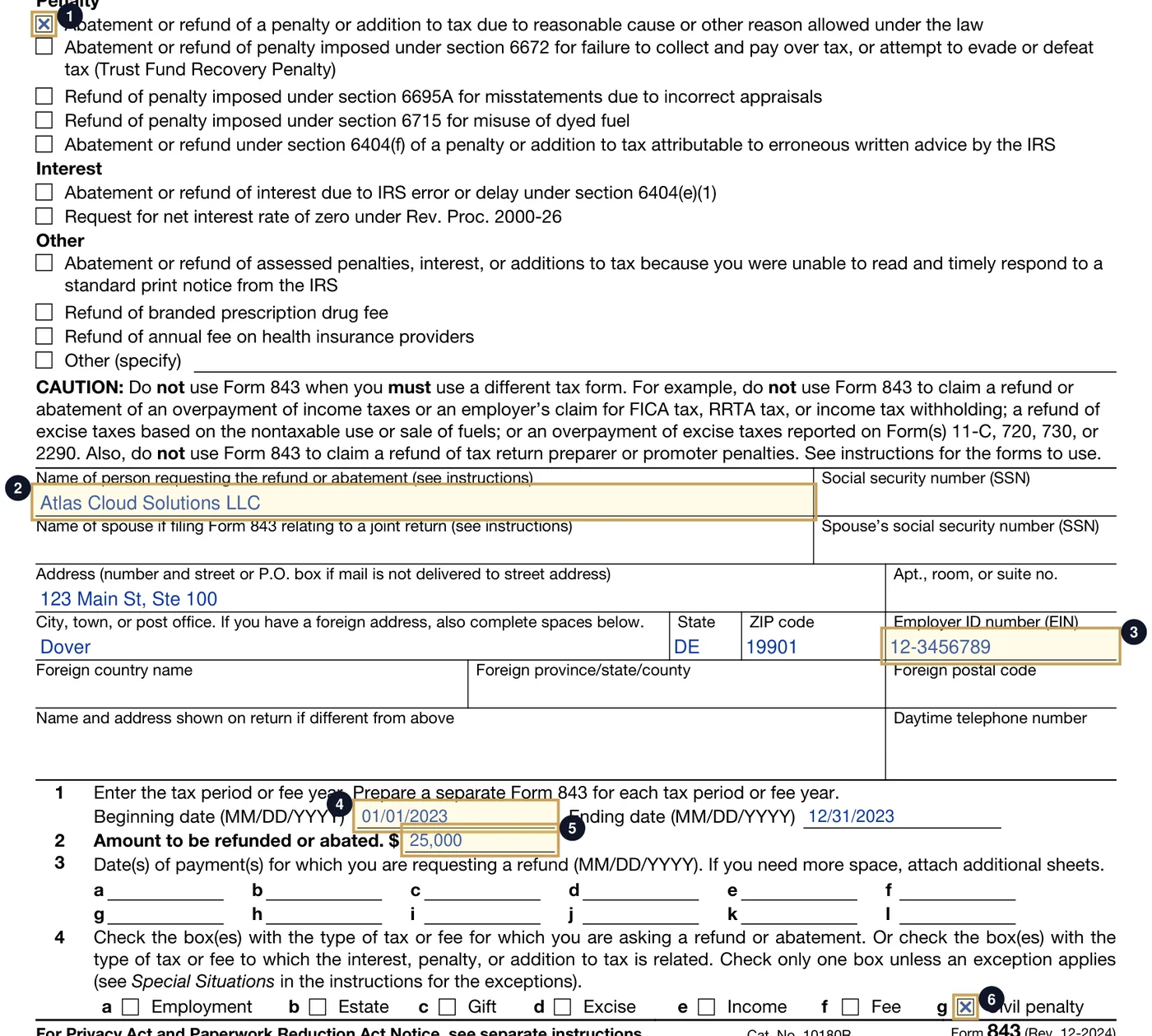
- 1Penalty: abatement due to reasonable cause
- 2Name of the LLC (the entity the penalty was assessed against)
- 3The LLC's EIN
- 4Line 1: the tax period (calendar year 2023)
- 5Line 2: the amount to abate
- 6Line 4g: Civil penalty
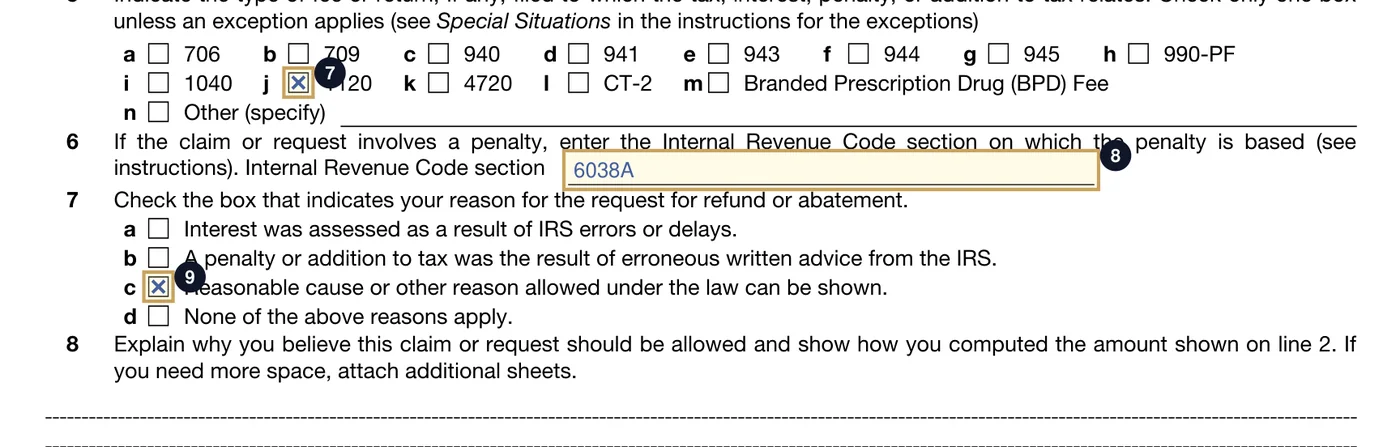
- 1Line 5j: 1120 (the pro forma return the Form 5472 was attached to)
- 2Line 6: Internal Revenue Code section 6038A
- 3Line 7c: reasonable cause can be shown
Line 8 refers to the attached reasonable cause statement.
Official IRS form, filled in with this guide's fictional example. Click to enlarge.- First-Time Abatement (FTA): the general IRS page lists failure-to-file, failure-to-pay and failure-to-deposit penalties (sections 6651, 6698, 6699, 6656), not the Form 5472 penalty. But the IRS manual adds an important exception. When the $25,000 penalty is assessed automatically because Form 5472 was attached to a late Form 1120, it "may be abated" under FTA if the related Form 1120 failure-to-file penalty was abated under FTA, or "would have been eligible for FTA abatement but a failure to file penalty wasn't assessed because there was $0 tax due". The taxpayer must also have had no similar Form 5472 penalties in the three prior periods, and the related Form 1120 must not have been filed late in the three prior periods (IRM 20.1.9.5.5). A pro forma Form 1120 shows $0 tax, so a first-time late filer may fit. Mention it in your response, alongside reasonable cause.
- After 90 days: the manual says that, generally, reasonable cause cannot extend beyond 90 days after the IRS notifies you of the failure, so the continuation penalty has no reasonable cause exception. Never let a notice sit.
Common mistakes to avoid
- Filing Form 5472 alone without Form 1120: for a foreign-owned LLC, the instructions require Form 5472 to be attached to a pro forma Form 1120.
- Filling out income and expense lines on Form 1120: the instructions only ask for the name, address and items B and E. Anything more makes the pro forma look like a real corporate return and can trigger confusing letters.
- Mailing the return to the standard Form 1120 address: foreign-owned U.S. DEs must use the dedicated fax number or the Ogden PIN Unit address.
- Combining multiple tax years into one Form 5472: Each tax year requires its own distinct Form 1120, Form 5472, and supporting statements.
- Omitting capital contributions and distributions: many owners report nothing even though they moved personal money into or out of the LLC. These are reportable transactions: check the Part V box, attach the statement, and include them in line 1f.
- Leaving the FTIN box empty: a foreign-owned LLC must enter the owner's FTIN on line 4b(3), or "None"/"N/A" if there is none.
- Failing to keep proof of delivery: If the IRS assesses late penalties, your fax confirmation or delivery receipt is essential evidence to prove the date of submission.
Your checklist
- Identify every past calendar year for which your foreign-owned LLC did not file Form 5472.
- Reconstruct your LLC’s financial statements and record all money transfers between the company and yourself.
- Download the relevant year versions of Form 1120 and Form 5472.
- Fill out page 1 of the pro forma Form 1120, writing "Foreign-owned U.S. DE" across the top.
- Fill out Form 5472 (the revision for that year), completing Parts I, II, III, IV, V and VII.
- Write, sign and date a reasonable cause statement for each year, ending with a penalties-of-perjury declaration.
- Collate the documents for each tax year into a separate, distinct packet.
- Fax the packet to the IRS PIN Unit at 855-887-7737 or mail it to the Ogden address.
- Store a complete physical copy, transmission receipts, and delivery logs in your corporate files.
- Monitor LLC mail for any IRS responses or automated penalty notices.
Official resources
- Form 5472 (PDF): The official information return form for foreign-owned reporting corporations.
- Instructions for Form 5472 (PDF): IRS line-by-line rules, definitions, and filing instructions.
- About Form 5472: the IRS page for the form, with the latest updates.
- Form 1120 (PDF): The US Corporation Income Tax Return, used as the pro forma cover.
- Delinquent International Information Return Submission Procedures: Official guidelines for submitting past-due international forms.
- Penalty relief for reasonable cause: how the IRS looks at reasonable cause requests.
- IRS manual, IRM 20.1.9: the IRS's internal rules for international penalties, including Form 5472 reasonable cause and First-Time Abatement (section 20.1.9.5.5).
- Form 843 (PDF): The official form used to request abatement or claim a refund of assessed penalties.
- Instructions for Form 843 (PDF): Filing addresses, statutory categories, and instructions for Form 843.
Frequently asked questions
Will the IRS automatically charge the $25,000 penalty if I file late?
It can. The IRS says that during processing "penalties may be assessed without considering the attached reasonable cause statement." The statement is still worth attaching: it documents your explanation from day one, and you can resubmit it when you answer the penalty notice.
Can I file late Form 5472 returns online?
No. Under current IRS processing rules, a foreign-owned US disregarded entity cannot file Form 5472 or its accompanying pro forma Form 1120 electronically. Submissions must be made by mail or fax to the dedicated PIN Unit in Ogden, Utah.
What should I do if I receive a penalty notice from the IRS?
Do not panic, but do not ignore it. Answer by the deadline on the notice, following its instructions. To request abatement, Form 843 goes to the return address on the notice, with your reasonable cause statement, proof of filing and supporting documents.
How many years of late Form 5472 returns can the IRS audit?
Under Internal Revenue Code section 6501(c)(8), when information required under section 6038A (such as Form 5472) is not furnished, the time to assess tax for the related return or period does not expire before 3 years after the information is furnished. In practice, an unfiled year stays open, which is another reason to file the missing years.
Catching up on past-due IRS forms can feel daunting, but addressing delinquent returns methodically is the most reliable way to protect your business. If you have received an IRS penalty notice or need professional support preparing your late filings, check our Penalty & Notice Resolution service or start with the free check.
Keep reading
Form 5472 Line-by-Line Guide for Foreign-Owned US LLCs
Learn how to fill out Form 5472 and pro forma Form 1120 for your foreign-owned single-member US LLC. Line-by-line guide, worked example, fax and mailing rules.
Read the guide1040-NR Foreign LLC Owner: Do You Need to File?
Wondering if you must file Form 1040-NR as a foreign LLC owner? Learn how ECI, US trade or business status, and tax treaties affect your return.
Read the guideThis article is general information about US tax rules for foreign-owned LLCs, not advice for your specific situation. Rules change; check the date above and ask before you file.